
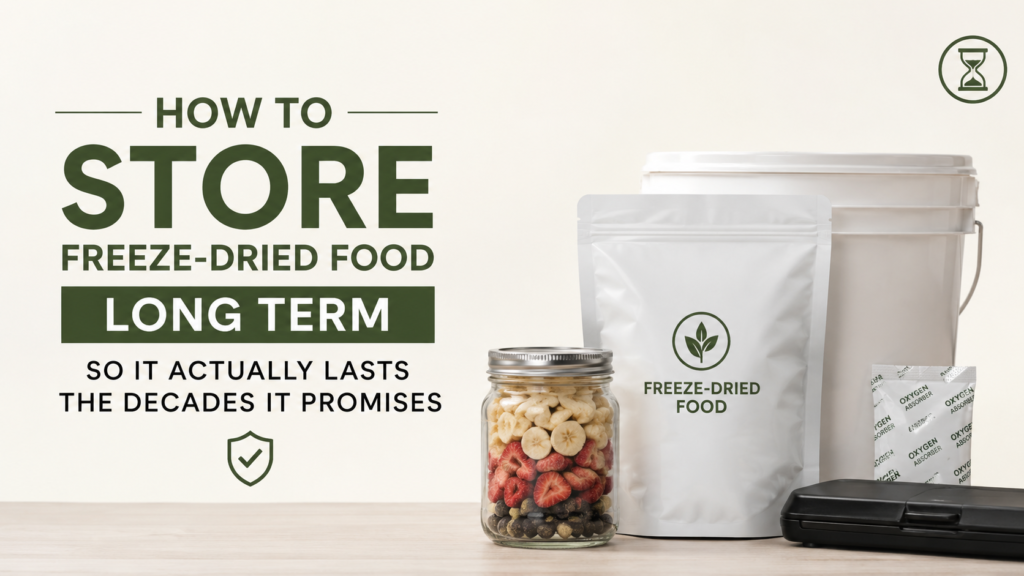
The thirty-year shelf life claims printed on freeze-dried food packaging always come with an asterisk that not enough people actually read closely: “under proper storage conditions.” I learned this the slightly hard way when a batch I’d left in a garage through several seasons of significant temperature swings didn’t taste nearly as good as a similarly aged batch I’d kept in a stable indoor pantry environment the entire time. Here’s exactly how to store freeze-dried food long term so you genuinely get the shelf life the packaging promises, rather than a disappointing fraction of it.
Why Storage Conditions Matter So Much for Freeze-Dried Food
Freeze-drying removes the vast majority of moisture from food, which is precisely what gives it such an exceptional shelf life in the first place — without moisture present, the bacterial and enzymatic processes that normally cause spoilage simply can’t get going effectively. But this advantage is genuinely fragile: if moisture finds its way back in, or if heat accelerates the slow chemical degradation of nutrients and flavour compounds over time, the dramatic shelf life advantage shrinks considerably from what the packaging originally promised.
The Three Conditions That Matter Most
1. Temperature: Cool and Stable
Heat is genuinely the single biggest enemy of long-term freeze-dried storage. Ideally, store freeze-dried food below 21°C, and just as importantly, avoid significant temperature fluctuation throughout the year. A garage or shed that swings from freezing in winter to genuinely hot in summer will degrade quality considerably faster than a stable indoor pantry, even if the average temperature across the whole year looks broadly similar on paper. This is precisely why an interior pantry or a cool basement consistently outperforms outbuilding storage for genuine long-term goals.
2. Moisture: Keep It Out Completely
This is genuinely non-negotiable. Once a freeze-dried pouch has been opened, the remaining contents need to either be consumed promptly or transferred to a properly airtight container, ideally with a moisture-absorbing packet included, to maintain the dry environment the food actually needs to stay stable. Unopened, factory-sealed pouches handle this automatically through their own design — it’s specifically opened or repackaged freeze-dried food that requires this kind of careful, deliberate handling.
3. Light: Store in the Dark
Light exposure accelerates the degradation of certain nutrients and can affect flavour over genuinely long storage periods. A dark pantry or cupboard is considerably better than a shelf exposed to direct sunlight, or even simply bright artificial light for extended periods throughout the day.
Should You Repackage Freeze-Dried Food?
For unopened factory pouches from reputable brands — see our comparison of Mountain House vs Backpacker’s Pantry — the original packaging is specifically designed for long-term storage and genuinely doesn’t need repackaging; just store it in the right conditions described above. If you’ve opened a pouch and have leftover contents remaining, transfer them to a proper airtight container, ideally including an oxygen absorber packet, rather than relying on simply folding the original pouch closed and hoping it holds.
- How to Stop Pantry Shelves Sagging Under Weight (Before They Fail Completely)
- Do Mothballs Kill Pantry Moths? What You Need to Know Before Using Them Near Food
- Can Organisation for Your Pantry: The Best Ways to Store Tins So You Can Actually Find Them
- How to Repurpose an Old Bookcase as a Kitchen Pantry (We’ve Done It Twice)
- Best Paint for Pantry Shelves: What We’d Use and Why It Matters
Bulk Storage Considerations
If you’re building a substantial freeze-dried stock as part of a broader emergency pantry — see our guide on building a 3-month emergency food pantry — organise your storage by purchase date and apply a first-in-first-out rotation even though the rated shelf life is genuinely very long. This ensures older stock gets used, or at minimum properly checked, before it approaches the upper end of its rated shelf life, and prevents the awkward situation of accidentally having your entire stock expire within the same narrow window years down the line.
How to Check If Stored Freeze-Dried Food Has Degraded
Before eating long-stored freeze-dried food, check the pouch carefully for any signs of swelling, which would indicate that moisture or bacterial activity has somehow gotten in, even though this shouldn’t normally happen with a properly sealed factory pouch but is genuinely worth checking regardless. After opening, check for any off smells or unusual texture changes before committing to preparing the full meal. Properly stored freeze-dried food from a reputable brand, kept cool, dry, and dark throughout its storage life, genuinely does maintain quality remarkably well across its full rated shelf life.
The Bottom Line
The thirty-year shelf life claims associated with quality freeze-dried food are genuinely achievable in practice — but only with proper storage conditions maintained consistently. Cool, dry, dark, and stable are the four pillars that matter most, and skipping any single one of them meaningfully shortens the practical shelf life you’ll actually get in reality, regardless of what the original packaging confidently promises.
Choosing the Right Storage Location in Your Home
Putting the four pillars above into practice means thinking carefully about exactly where in your home you store your freeze-dried stock, rather than simply finding any available cupboard space. An interior pantry, ideally one without exterior walls that experience significant temperature swings, generally outperforms a garage, shed, or loft space for this specific purpose, even though those locations might seem like obvious choices simply because they’re often less cluttered with everyday items. If your only realistic option is a less ideal location like a garage, consider insulating the specific storage area or using a dedicated storage container designed to buffer against temperature and humidity fluctuation, rather than simply accepting the more variable conditions as unavoidable.
For households building a genuinely serious long-term stockpile rather than just a handful of pouches for occasional camping use, it’s worth treating the storage location decision with the same seriousness as the purchasing decision itself. The most expensive, highest-quality freeze-dried meals in the world will still underperform their rated shelf life if stored in a garage that swings between freezing winters and uncomfortably hot summers, while a more modest selection stored properly in a stable interior pantry will likely outlast them in terms of genuine retained quality.