
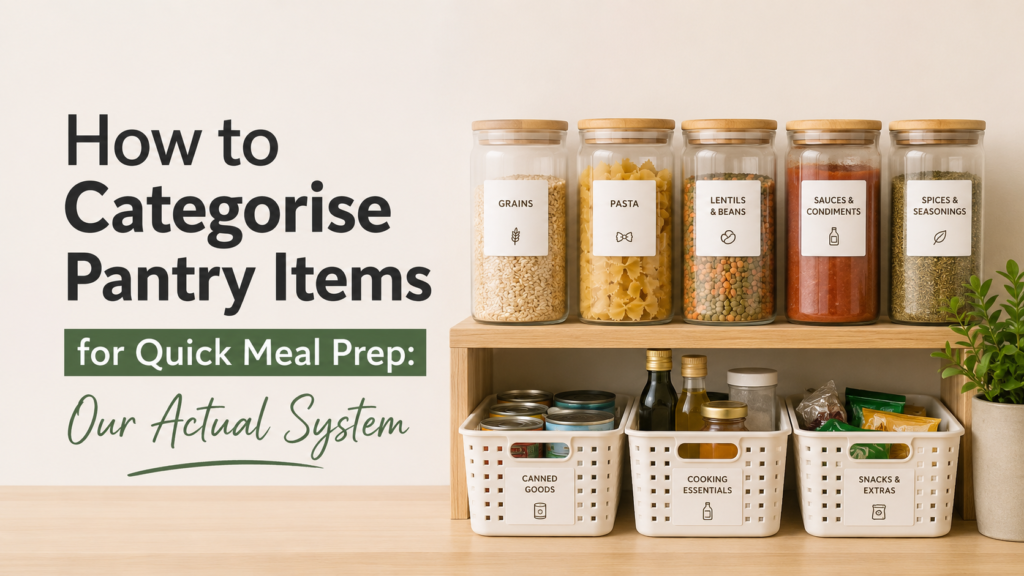
How to Categorise Pantry Items for Quick Meal Prep. Most pantry organisation guides suggest categorising by food type — grains together, baking together, tins together. We tried this for years, and it worked reasonably well, but the system that actually made meal prep faster was a different categorisation altogether: organising around how we cook rather than what the food is. Here’s our actual system for categorising pantry items for quick meal prep, and why the shift from food type to cooking workflow made a noticeable difference.
- Best Can Storage Rack for Your Pantry: What We’d Actually Buy
- Rice Storage Containers: The Best Options for Keeping Rice Fresh and Pest-Free
- Best Pantry Inventory Apps: How to Track Your Food Stock Without Losing Your Mind
- Best Pantry App 2026: The Top Apps for Tracking What You Have at Home
- What Food Does Not Go Bad? The Genuinely Long-Lasting Pantry Staples Worth Stocking
Why Standard Food-Type Categories Don’t Optimise for Cooking
When you’re making a pasta dish, you need pasta (grains section), a tin of tomatoes (tins section), some dried herbs (spices section), olive oil (oils section), and possibly a tin of beans (also tins section). These ingredients are stored in four different zones based on their food type, which means four trips to different parts of the pantry or a lot of mental cataloguing before you start. Organising by cooking workflow puts related ingredients within reach of each other rather than scattered according to what category they happen to fall into.
Our Cooking-Workflow Pantry Zones
Zone 1: Quick Weeknight Dinners
Everything needed for the five or six meals we make most often on weeknights: pasta, rice, tinned tomatoes, tinned beans, stock cubes, soy sauce, the specific spices we reach for in these dishes. These are grouped at the most accessible height — eye level, right at the front. We cook these meals multiple times a week, so they deserve the prime real estate.
Zone 2: Baking and Weekend Cooking
Flour, sugar, baking powder, yeast, vanilla extract, cocoa, chocolate chips, and the other ingredients that come out for weekend baking or more involved weekend cooking. These live together but slightly out of the daily grab zone since we don’t need them every day. We cover the dedicated approach to baking supplies specifically in our guide on organising baking supplies in the pantry.
Zone 3: Backup and Bulk Stock
Extra tins, second bags of staples, anything bought in a multi-pack. These don’t need to be easily accessible for cooking — they’re restocking supplies rather than cooking supplies — so they go on the highest or lowest shelves, and we rotate using the FIFO approach described in our guide on using the FIFO method in your pantry.
Zone 4: Snacks and On-the-Go
Everything in our snack basket system is described in our guide on creating a snack basket system — this zone is deliberately separate from the cooking zones, so grabbing a snack doesn’t involve any interaction with the cooking organisation at all.
How We Adapted This to Our Specific Pantry
The zone layout above is our framework — your specific categories should reflect what you actually cook. If you make curries three times a week, a dedicated “curry night” section with all your spices, coconut milk, tinned tomatoes, and lentils grouped makes sense for you. If you bake almost daily rather than occasionally, the baking zone deserves prime position. The principle — organise around cooking frequency and workflow rather than food type — transfers even if the specific categories need adjusting for your household.


Our Honest Take
Reorganising our pantry around how we cook rather than what the food is made us meaningfully faster at weeknight cooking — not dramatically so, but noticeably. Less time hunting across different sections, fewer moments of “I know I have this somewhere,” and a more intuitive sense of what we have available for a given meal type. For anyone who does a significant amount of home cooking, the few hours it takes to rethink your pantry zones around actual cooking workflow rather than generic food-type categories is time that pays back quickly.