
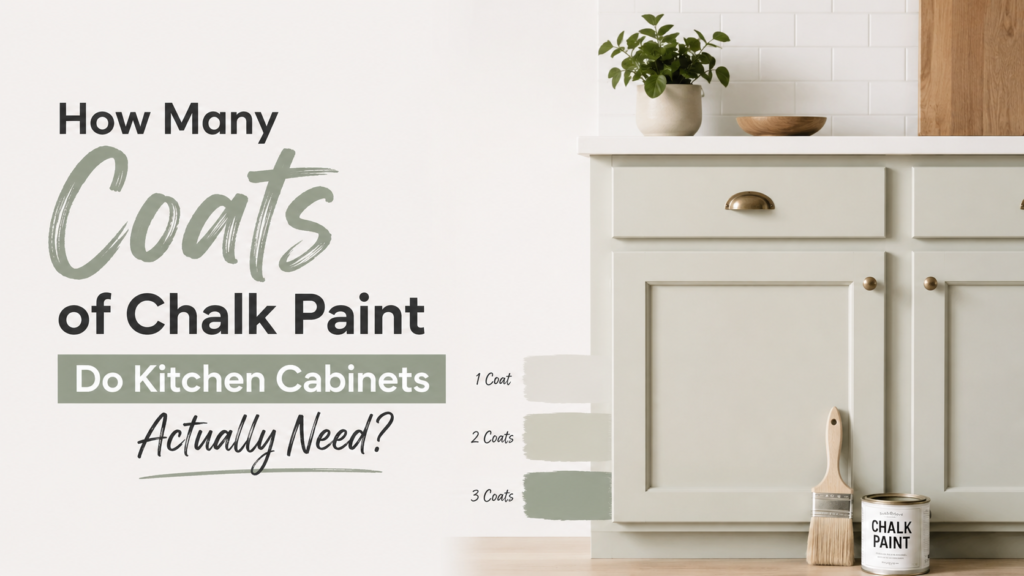
Underestimating how many coats of chalk paint a project actually needs is one of the most common reasons people end up genuinely disappointed with the finished result — patchy coverage, visible brush strokes showing clearly through the surface, or a colour that looks thin and uneven rather than rich and properly solid. I made this exact mistake on my own first chalk paint project, stopping after a single coat because it “looked basically done” while still wet, only to watch the original colour ghost through unevenly within a week of normal use. Here’s the honest, considered answer.
The Standard Answer: Two Coats Minimum
For the vast majority of chalk paint projects applied to kitchen cabinets, two coats represents the practical minimum for genuinely solid, even coverage. Chalk paint is considerably more porous and less opaque per coat than standard cabinet paint formulations, so a single coat — even one that looks reasonably solid while still wet — frequently reveals the original colour or underlying wood grain once it’s fully dried and the true coverage becomes apparent.
- Can Organisation for Your Pantry: The Best Ways to Store Tins So You Can Actually Find Them
- How to Repurpose an Old Bookcase as a Kitchen Pantry (We’ve Done It Twice)
- Best Paint for Pantry Shelves: What We’d Use and Why It Matters
- How Long Do Pantry Moths Live Without Food? What This Means for Clearing an Infestation
- Can Cats Eat Moths? Are Pantry Moths Harmful to Cats?
When You Might Need a Third Coat
- Going from dark to light: Painting a white or pale chalk paint colour over dark wood or existing dark paint almost always needs a genuine third coat for properly even coverage throughout.
- Unprimed bare wood: Raw wood absorbs considerably more paint into the grain than a previously painted or primed surface would, often requiring an extra coat to achieve the same level of opacity.
- Very saturated or unusual colours: Some specific pigments, particularly certain reds and deep blues, have inherently lower opacity and need an additional coat to achieve genuinely full, even colour across the whole surface.
How to Tell If You Need Another Coat
Let the current coat dry completely, then check the surface carefully from multiple angles under good lighting. Look specifically for patches where the underlying colour or wood grain shows through, areas that appear duller or more matte than the surrounding surface, often a sign of uneven absorption into the wood, and any visible colour variation across what should be a uniform surface. If you spot any of these issues, apply another coat rather than accepting the uneven result as final.
Should You Sand Between Coats?
A light sand with fine 320-grit sandpaper between coats isn’t strictly required for chalk paint in the way it is for some other paint types, but it does smooth out any surface texture and helps the next coat bond more evenly across the whole area. I’d genuinely recommend it as good practice, particularly between the final coat of paint and any subsequent sealant layer.
Drying Time Between Coats
Chalk paint typically feels dry to the touch within 30 to 60 minutes of application, but I’d recommend waiting at least an hour, ideally two, between coats for the genuinely best result — rushing this step can cause the layers to drag against each other and create an uneven texture that’s hard to correct afterward. Note that drying time and curing time are different things entirely — full curing takes considerably longer, as covered in our guide on whether chalk paint needs waxing or sealing, which addresses the curing process in much greater detail.
Don’t Forget the Sealant Coats
Coats of paint and coats of sealant are entirely separate considerations that shouldn’t be confused with each other. Once your two or three coats of chalk paint are fully dry, you’ll still need two to three additional coats of a proper sealant — wax, varnish, or hardwax oil — to make the finish genuinely durable enough for kitchen use. Skipping this step, regardless of how many paint coats you’ve carefully applied beforehand, leads directly to the marking and premature wear issues we cover in considerable detail in our dedicated chalk paint sealing guide.
My Practical Recommendation
Budget for two coats of chalk paint as your realistic starting assumption, with a strong likelihood of needing a genuine third coat if you’re going from a dark base colour to a considerably lighter one. Always check the fully dried result under good lighting before deciding the job is finished — the difference between “looks done” and “is actually evenly covered throughout” is often only visible once the paint has completely dried, rather than while it’s still wet and naturally looks more uniform than it will once fully set.
Working Efficiently When Multiple Coats Are Needed
If you already know going into a project that you’ll likely need three coats — for instance, painting white over a dark existing colour — it’s worth planning your overall timeline accordingly rather than discovering the need for an extra coat partway through and feeling frustrated by the delay. Allow a full day for two coats with proper drying time between each, and add at least a further half day if a third coat proves necessary. Painting cabinet doors flat, removed from their hinges and laid across a trestle or table, also speeds up the multi-coat process considerably compared to painting them in place, since you can work through several doors in sequence while earlier ones are drying, rather than waiting on a single surface before moving to the next stage of the job.
What Happens If You Apply Too Many Coats
While under-coating is the more common mistake, it’s worth briefly mentioning that excessive coats can cause their own problems, even though this happens less often than the opposite issue. Chalk paint applied too thickly across many unnecessary coats can begin to feel slightly chalky or powdery to the touch, lose some of the crisp definition around cabinet door panel details, and take considerably longer to fully cure than a more measured two or three coat application would. If you find yourself reaching for a fourth or fifth coat and the coverage still doesn’t look right, it’s worth stepping back and checking your actual application technique rather than simply continuing to add more paint, since a persistent coverage problem at that stage is more likely related to how the paint is being applied than to a simple lack of volume.
A thin, even application using a good quality brush or a foam roller, working in consistent, deliberate strokes, will generally achieve proper coverage within the two to three coat range discussed throughout this guide. If you’re consistently needing more than that, it’s worth reviewing your brush technique, the consistency of the paint itself, and whether the room temperature and humidity are within a reasonable range for the paint to behave as the manufacturer intended.
Testing Coverage Before Committing to a Full Kitchen
If this is your first time working with chalk paint, it’s genuinely worth testing your expected coat count on a single, less visible cabinet door before committing to the full kitchen. Paint that door with what you believe will be the right number of coats, let it cure fully for the recommended period, and assess the result critically under good lighting before moving on to every other cabinet in the room. This small test run, taking perhaps a day longer than diving straight into the full project, can save considerable frustration if it turns out your specific paint, colour, and surface combination genuinely needs an extra coat beyond what you’d initially budgeted for.
This approach also gives you a useful opportunity to dial in your brush or roller technique on a lower-stakes surface before tackling the doors that will be most visible day to day. Many people find their technique improves noticeably between the first and second cabinet door they paint, simply through the practice of doing it once already, and starting with a less prominent door means any early technique issues are less consequential than they would be on a highly visible feature like an island or a door directly opposite the kitchen entrance.
Summary
Two coats of chalk paint is the realistic minimum for most kitchen cabinet projects, with a third coat frequently needed when moving from dark to light colours or painting bare, unprimed wood. Always judge coverage on the fully dried result rather than how the paint looks while still wet, sand lightly between coats for the best bond, and remember that paint coats and sealant coats are separate, both equally necessary steps in achieving a finish that’s genuinely durable enough for daily kitchen use over many years to come.