
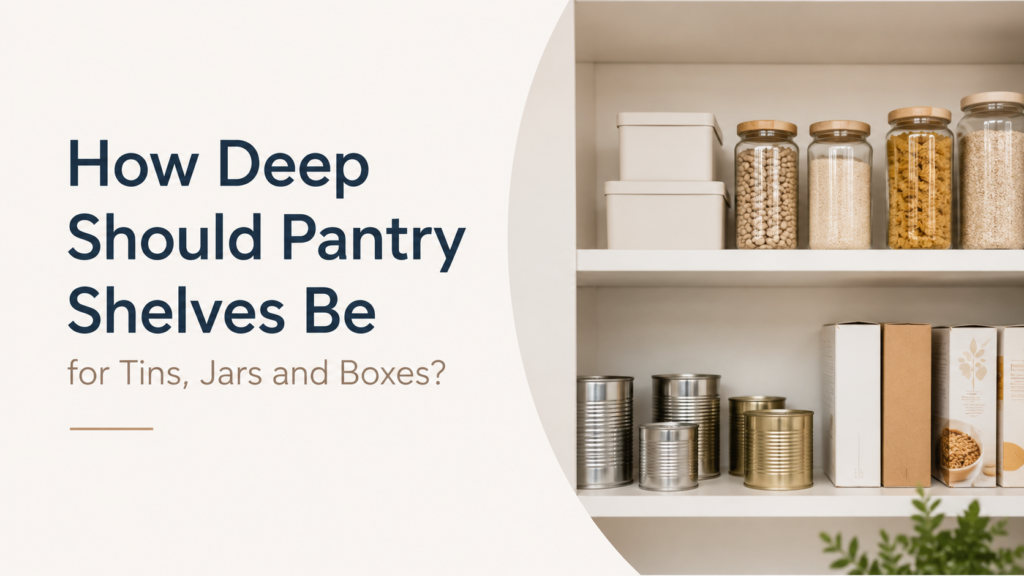
When I built my own DIY pantry shelves, covered in full in our guide on building DIY pantry shelves on a wall, the single decision I went back and forth on most was depth. Too shallow and you waste space; too deep and things get lost. Here’s the practical answer to how deep should pantry shelves be, broken down properly by what you’re actually storing rather than a single generic number that doesn’t suit every category of pantry item.
The General Rule: Depth Should Match Contents, Not Maximise Space
The natural instinct is to build the deepest shelf the available space allows, on the theory that more depth automatically equals more storage capacity. This is genuinely the wrong approach for pantry shelving specifically. Once depth exceeds what a single row of your most commonly stored items actually needs, you start losing items at the back rather than gaining any meaningful usable storage — precisely the problem we cover at length in our guide on shelving ideas for deep cabinets, which exists specifically because so many kitchens are built with cabinet depths that don’t suit pantry-style storage well.
Depth Guidelines by Item Type
Tins and Small Jars: 20 to 25 Centimetres
A standard tin is roughly 7 to 10 centimetres in diameter. A shelf depth of 20 to 25 centimetres allows a single visible row with a small amount of buffer space — enough to see and grab every single item without anything hiding behind another tin in front of it.
Cereal Boxes and Tall Packaged Goods: 25 to 30 Centimetres
Most cereal and cracker boxes measure around 20 centimetres deep; a shelf of 25 to 30 centimetres gives enough depth for a comfortable single row without excessive wasted space sitting behind them unused.
Large Bottles, Oils and Sauces: 12 to 15 Centimetres
Bottles are typically narrower in profile than tins when viewed from the front, though considerably taller — shelf depth here can be shallower, since the limiting factor for bottle storage is generally height rather than depth.
Bulk Storage Containers: 25 to 35 Centimetres
Containers like the PANTRYSTAR large 5.2-litre airtight containers typically need a slightly deeper shelf — check the specific product dimensions, but 25 to 35 centimetres comfortably accommodates most large-format airtight containers with a small margin to spare for easy removal and replacement.
Double-Row Storage With a Front and Back Row: 35 to 45 Centimetres
If you specifically want a front row of frequently-used items and a back row of backup stock — a strategy we discuss in detail in our deep cabinet guide — a depth of 35 to 45 centimetres accommodates two genuinely usable rows, though this approach requires real discipline about only using the back row for things you don’t need quick daily access to.
Why Shallower Is Almost Always Better for Visibility
The most common pantry organisation complaint — losing track of what you actually have, buying unnecessary duplicates, finding expired items pushed to the back of a shelf months after they should have been used — is almost always fundamentally a depth problem rather than a quantity problem. A genuinely well-organised pantry built on shallow, single-row shelving, typically 20 to 30 centimetres for most categories, keeps everything visible at a glance, which is consistently the single biggest factor in actually maintaining organisation over the long term rather than gradually sliding back into chaos.
What If Your Existing Pantry Has Deep Shelves Already?
You don’t necessarily need to rebuild from scratch — see our guide on pantry shelving ideas for deep cabinets for retrofitting solutions including pull-out shelves, tiered risers, and the disciplined front-row and back-row approach that makes an overly deep existing shelf genuinely work effectively, without needing any construction or major renovation.


A Practical Starting Point If You’re Building From Scratch
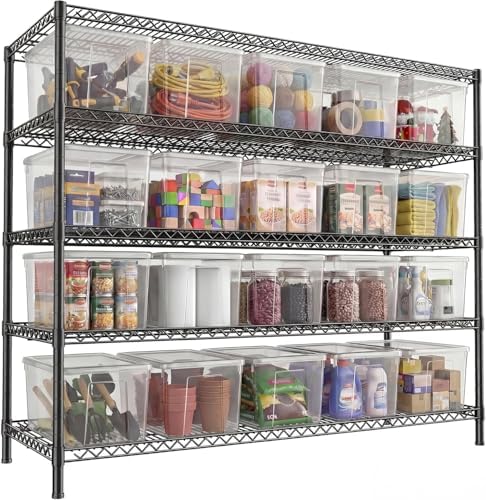
If you’re building new shelving and want a single depth that works reasonably well across most pantry categories without overthinking the decision excessively, 25 to 30 centimetres represents the practical sweet spot — deep enough to comfortably accommodate cereal boxes and most standard containers, while remaining shallow enough to keep everything genuinely visible for the tins and jars that make up the bulk of most pantry contents.
Combining Different Depths Across a Single Pantry
For most households, the ideal approach genuinely isn’t a single uniform shelf depth throughout the entire pantry, but rather a thoughtful mix calibrated to what each specific shelf is intended to hold. A shallower shelf near eye level, dedicated to everyday tins and jars, paired with a slightly deeper shelf lower down for bulkier containers and backup stock, makes considerably better use of the available space than forcing every shelf to the same depth regardless of contents. If you’re planning new shelving, take the time to sketch out roughly what will live on each level before finalising the depth, since this small bit of upfront planning consistently produces a more genuinely usable result than a uniform approach decided without much specific thought.
Measuring Your Actual Items Before Committing to a Depth
Rather than relying purely on the general guidelines above, it’s genuinely worth taking ten minutes to measure your own most commonly used items before finalising any shelf depth decision. Pull together a representative selection of what you actually buy regularly — a few tins, a cereal box, a bottle of oil, whatever container sizes you’ve settled on for your dry goods — and measure the depth of each from front to back. This gives you a far more accurate picture than generic guidelines can provide, since brands and product ranges genuinely do vary, and a household that buys predominantly from one particular supermarket’s own range might find their typical tin depth differs noticeably from the averages quoted in general guides like this one.
Once you have these real measurements, add a small buffer of two or three centimetres to whatever the deepest regularly-stored item measures, and that becomes your target shelf depth for that particular category. This approach takes a little more effort upfront than simply adopting a generic number, but it produces shelving that’s genuinely tailored to your actual pantry contents rather than an averaged guess that might not quite match what you really buy and store week to week.
What Happens If You Get the Depth Wrong
It’s worth knowing that getting shelf depth slightly wrong isn’t necessarily a permanent problem requiring a full rebuild. If a shelf turns out shallower than ideal, you can often compensate by using slightly smaller containers than you’d originally planned, or accepting a marginally less generous single row rather than the more spacious arrangement you’d hoped for. If a shelf turns out deeper than ideal, the retrofitting solutions covered in our guide on pantry shelving ideas for deep cabinets — pull-out drawers, tiered risers, or a disciplined front-and-back-row system — can recover much of the lost practical usability without requiring you to remove and rebuild the shelf itself from scratch.
This is genuinely reassuring to know before undertaking a shelving project, since the fear of getting the measurement wrong can otherwise lead to excessive over-planning and delay. A shelf depth that’s reasonably close to the guidelines above, even if not perfectly calibrated to your exact items, will still function considerably better than no organised shelving at all, and minor depth mismatches are almost always recoverable with one of the retrofitting approaches covered elsewhere on this site.
The Relationship Between Shelf Depth and Overall Pantry Capacity
One final consideration worth addressing directly: choosing shallower shelves throughout your pantry, as this guide generally recommends, does mean accepting somewhat less raw storage volume than a deeper shelf would technically provide. This trade-off is genuinely worth making for the vast majority of households, since the practical usability gained from being able to see and reach everything easily outweighs the theoretical capacity lost from not using every available centimetre of cabinet depth. A pantry that holds slightly less but where everything is genuinely visible and accessible will serve you better day to day than one that holds marginally more but where a meaningful portion of that capacity is effectively unusable because it’s hidden behind other items or pushed too far back to reach comfortably.
If raw capacity is genuinely a pressing concern in your specific situation — perhaps due to a larger household or a strong preference for bulk buying — it’s better to address that need by adding more shelves vertically, or by extending shelving across additional walls, rather than by simply making each individual shelf deeper than the guidelines above suggest. This approach preserves the visibility and accessibility benefits of shallower shelving while still meaningfully increasing your overall storage capacity through genuine additional shelf space rather than wasted depth.